


Writing a research paper begins before the first section of the main text. The title, abstract and introduction are essential because they help the reader understand what the paper is about, why the topic matters and what the author wants to examine. However, students often make similar mistakes in these parts of the paper: titles are too general, abstracts are written like introductions and research objectives are unclear.
This article explains the most common mistakes in the title, abstract and introduction of a research paper and shows how to avoid them. For how these parts fit into the paper as a whole, see the structure of a research paper.
1. Title of the paper: most common mistakes
The title is the first element of the paper. It should clearly inform the reader what the article is about. A good title is concise, specific and informative.
Most common mistakes
- The title is too long.
- The title is too short and does not explain the topic.
- The title is too general.
- The title contains too many prepositions and articles.
- The title begins with vague expressions like: “Study about…”, “Research on…”, “Report on…”, “Investigation concerning…”, “Results of a study about…”, “Analysis of the results of…”, “Some aspects of…”
- The title does not indicate the main topic, population, context or problem.
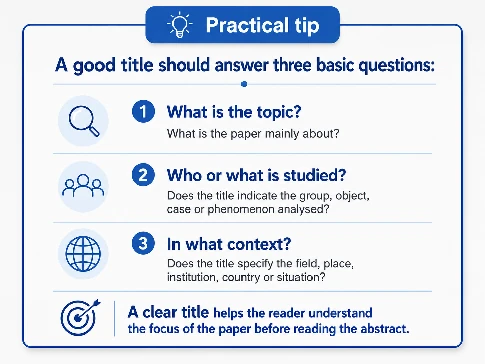
Weak example: Study about the use of artificial intelligence by students in academic writing
Better version: University students’ use of generative artificial intelligence in academic writing

2. Abstract: most common mistakes
The abstract is a short summary of the whole article. It should briefly present the objective, methodology, main results and basic conclusions of the research.
Most common mistakes
- The abstract is written like an introduction.
- It only presents the topic.
- It does not mention the objective of the study.
- It does not explain the methodology.
- It includes too many details.
- It includes examples.
- It includes citations.
- It is too long.
- It is written before finishing the paper.
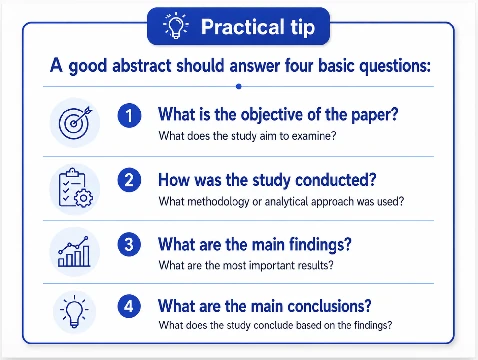
Recommendations for writing a good abstract
When writing an abstract, authors should follow several basic rules.
-
First, the length of the abstract should be limited to the number of words indicated or recommended by the journal in which the article will be submitted. Some journals accept abstracts of 150 words, while others allow 200 or 250 words, so it is important to check the author guidelines before writing.
-
Second, the abstract should usually be written as one single paragraph. It should be concise, coherent and easy to read. It should not be divided into long explanations or unnecessary details.
-
Third, the abstract should be written in an impersonal style and mainly in the past tense, because it presents what was done in the study. For example, authors may write: “The study analysed…”, “Data were collected…” or “The results showed…”. However, conclusions are often written in the present tense, because they express the current meaning or implication of the findings. For example: “The findings suggest…” or “The study highlights…”.
3. Introduction: most common mistakes
The introduction presents the topic, explains why it is important and leads the reader to the research problem, objective or question.
Most common mistakes
- The introduction is too general.
- It starts with obvious statements.
- It does not explain why the topic matters.
- It does not identify a research gap.
- It does not present the objective of the paper clearly.
- It includes too much theory.
- It includes results too early.
- It is not connected to the rest of the paper.
Frequent weak beginnings
“Nowadays…”
“In today’s world…”
“Since ancient times…”
“This topic is very important…”
“Many researchers have studied this topic…”
“Technology is developing very fast…”
These openings are weak because they are too broad, obvious and unspecific. A good introduction should not begin with a general statement that could fit any paper. It should introduce the topic in a focused way and quickly guide the reader towards the specific research problem.
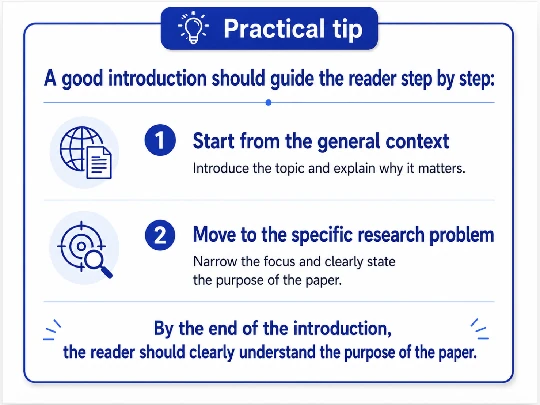
How to check if your introduction is good?
A good introduction should not only present the general topic of the paper. It should also help the reader understand the logic of the study: what the paper is about, why the topic matters and what the research aims to achieve.
Before submitting your paper, check whether your introduction answers the following questions:
1. Does the introduction clearly explain what, why and for what purpose the research was conducted?
The reader should understand the main topic of the study, the reason why it is important and the purpose of the research.
2. Does it present what is already known about the research problem?
The introduction should briefly present the current state of knowledge based on the most relevant previous studies. Its role is to show what has already been established about the topic before introducing the specific problem of the paper.
3. Does it explain what is still unclear, controversial or insufficiently studied?
A strong introduction shows that the topic has not been fully explored. It may indicate a research gap, an unresolved problem or an aspect that requires further analysis.
4. Does it explain why the present study is necessary?
The introduction should show the value of the research conducted by the author. The reader should understand why this study is worth doing and how it may contribute to existing academic knowledge.
5. Are the research objectives clearly formulated?
At the end of the introduction, the objective of the paper should be clear, specific and connected to the rest of the article.
6. Are research questions or hypotheses included, if needed?
In some research papers, authors also formulate research questions or hypotheses. Research questions indicate what the study seeks to answer, while hypotheses present expected relationships or assumptions that will be tested in the study.
After reading the introduction, the reader should know what the study is about, what is already known, what is still missing and what the author intends to examine.