


Writing a scientific research article requires more than presenting interesting ideas or results. A good article should follow a clear and logical structure that helps readers understand the purpose of the study, the methods used, the findings obtained and their significance. Although the exact format may vary depending on the discipline, journal or publisher, most scientific articles include a set of common sections. Understanding the role of each part is essential for anyone who wants to write clearly, professionally and according to academic standards.
This guide walks through the typical structure of a scientific research article, section by section.
1. Title
The first element is the title. It introduces the topic of the article and should clearly reflect its content. It should:
- Be attractive, capturing attention.
- Be clear, accurate, brief and concise.
- Enable the reader to easily identify the topic.
2. Abstract
The abstract is a short summary of the paper. It briefly presents the problem, the objective, the methodology, the main findings and the conclusions.
An abstract should follow a clear structure: introduction to the problem, research objective, methodology, results and key conclusions. It should be written as one paragraph, usually in the present tense and in the third person singular. It should not include citations, abbreviations or repeat the title of the article. In most cases, an abstract should not exceed 200 to 250 words.

3. Keywords
Keywords are the main terms that describe the main content of the paper. They help readers, databases and search engines find the article. Good keywords should be specific enough to represent the topic clearly. Usually, 3 to 5 keywords are provided, separated by commas. They may be single words or phrases.

4. Introduction
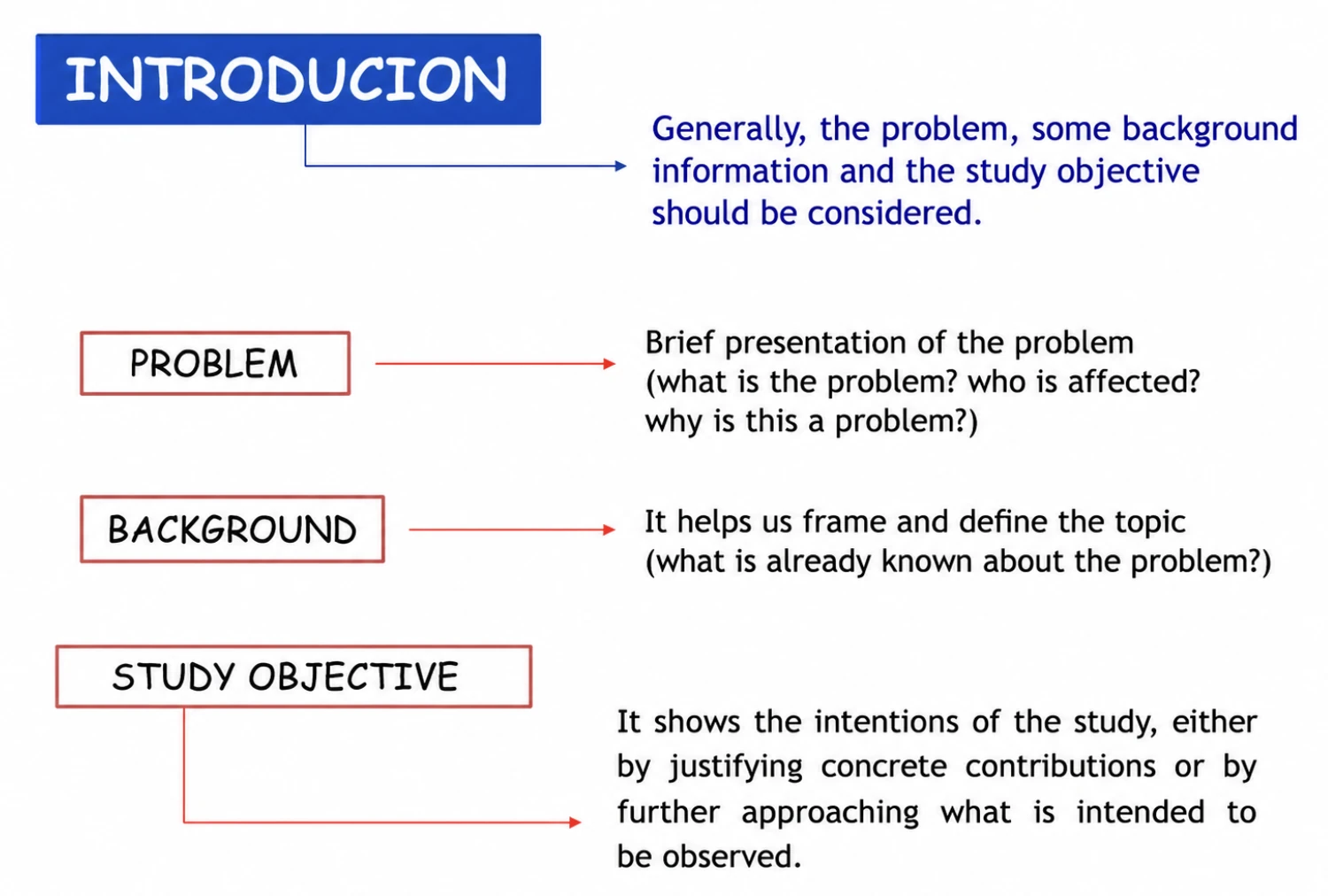
The introduction is one of the most important parts of a scientific article because it prepares the reader for the whole study. A good introduction should clearly explain what the research is about, why the topic is important and what the purpose of the study is.
It should also present the background of the problem by referring to the most relevant previous studies. This helps the reader understand what is already known about the topic and where the current study is located within the existing scientific discussion.
Another important element of the introduction is to show which aspects of the topic are still unclear, controversial or insufficiently studied. This allows the author to justify the need for the research. Finally, the introduction should clearly formulate the objectives of the study and, when appropriate, research questions or hypotheses.

5. Literature review or theoretical framework
The literature review is the first main section of the paper and acts as the paper’s presentation card. It presents previous research related to the topic. Its purpose is to organize and critically discuss the most relevant knowledge, rather than to list as many publications as possible.
The literature review presents the most relevant previous studies related to the topic. It shows what is already known, what has been studied before and where the research gap may exist. In this section, it is important to cite relevant authors correctly, according to the citation style required by the journal. In many cases, journals use APA Style, but the author should always check the specific author guidelines before submitting the article.
In some papers, this section is called the theoretical framework. In that case, it presents the theories, concepts or models used to interpret the research problem.

6. Methodology
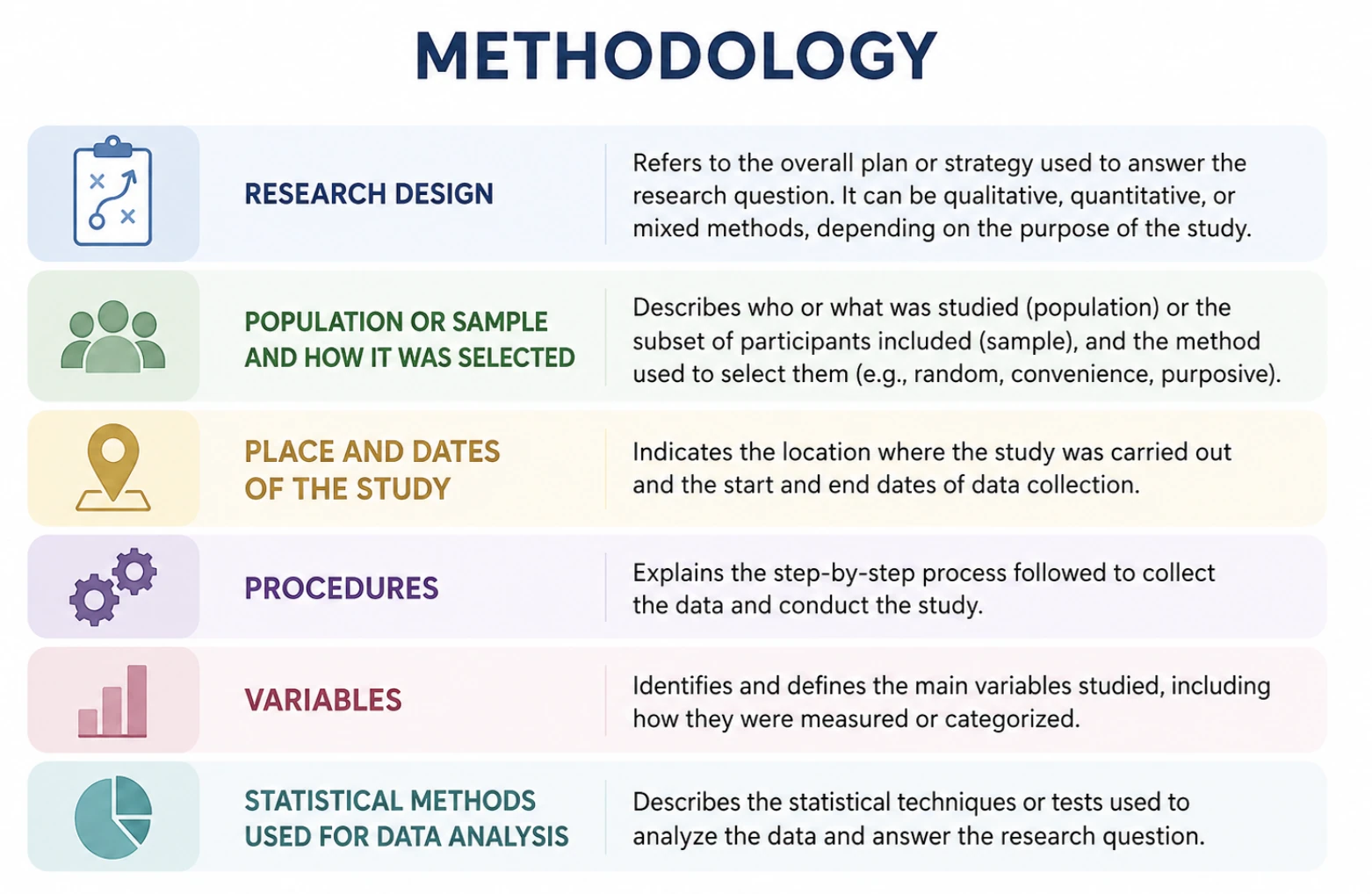
The methodology section explains how the research was conducted. It should describe the research design, data sources, sample, instruments, procedures and methods of analysis.
The main purpose of this section is transparency. Other researchers should be able to understand how the research was carried out and evaluate whether the method was appropriate.
In empirical papers, the methodology section is especially important because weak or unclear methodology can reduce the credibility of the entire paper.

7. Results or findings
The results section presents the main findings of the study. These findings may be shown in text, tables, charts or figures.
Results should be presented clearly and logically. Tables and figures should not be decorative. They should help explain important information. Every table or figure included in the paper should be mentioned and discussed in the text.
A common mistake is to repeat the same information in the text and in a table. It is better to use tables and figures for synthesis and use the text to highlight the most important findings.
All tables and figures should be cited in the text of the article, with comments on the most relevant data, so that readers can understand the key results without needing to consult them in detail and without unnecessary repetition. Learn more about formatting tables correctly in APA Style.

8. Discussion
The discussion section interprets the results. It explains what the findings mean and how they relate to previous research, theory or practice.
This is one of the most important parts of a research paper because it shows the author’s ability to think critically. The discussion should not simply repeat the results. It should explain their relevance, compare them with other studies and indicate possible implications.
A good discussion answers questions such as: What do the results suggest? Are they consistent with previous research? Do they confirm or challenge existing knowledge? What are their limitations?
9. Conclusions
The conclusion presents the main contribution of the paper. It should be based on the results and discussion, not on unsupported claims.
The conclusion should be based on the data and results presented in the article. However, it should not simply repeat the results. Its role is to show what can be concluded from the study and how these conclusions respond to the research objective. It should also include suggestions for future research.
10. References
The reference list includes all sources cited in the paper. It should follow the required citation style, such as APA or another academic standard. For a step-by-step walkthrough, see our guide on how to prepare an APA reference list.
The most important rule is consistency. Every source cited in the text should appear in the reference list, and every item in the reference list should be cited in the text.
11. Appendices (optional)
Finally, appendices may include additional materials, such as questionnaires, detailed tables, interview guides or other supporting documents.