


In academic writing, students often use different types of sources: journal articles, newspaper articles, and websites. Each of these sources requires a slightly different reference format in APA 7. This is why it is not enough to copy a link and place it at the end of the assignment. A correct reference should include key information such as the author, date, title, source, and DOI or URL when available.
Before reading this guide, it may be useful to review the general article APA Style: How to Prepare a Reference List, where we explain what a reference list is and why a list of links is not enough. If you need help with books, see also Book References in APA 7: Practical Examples and 6 Basic Rules for Book References in APA 7.
1. Journal article with DOI
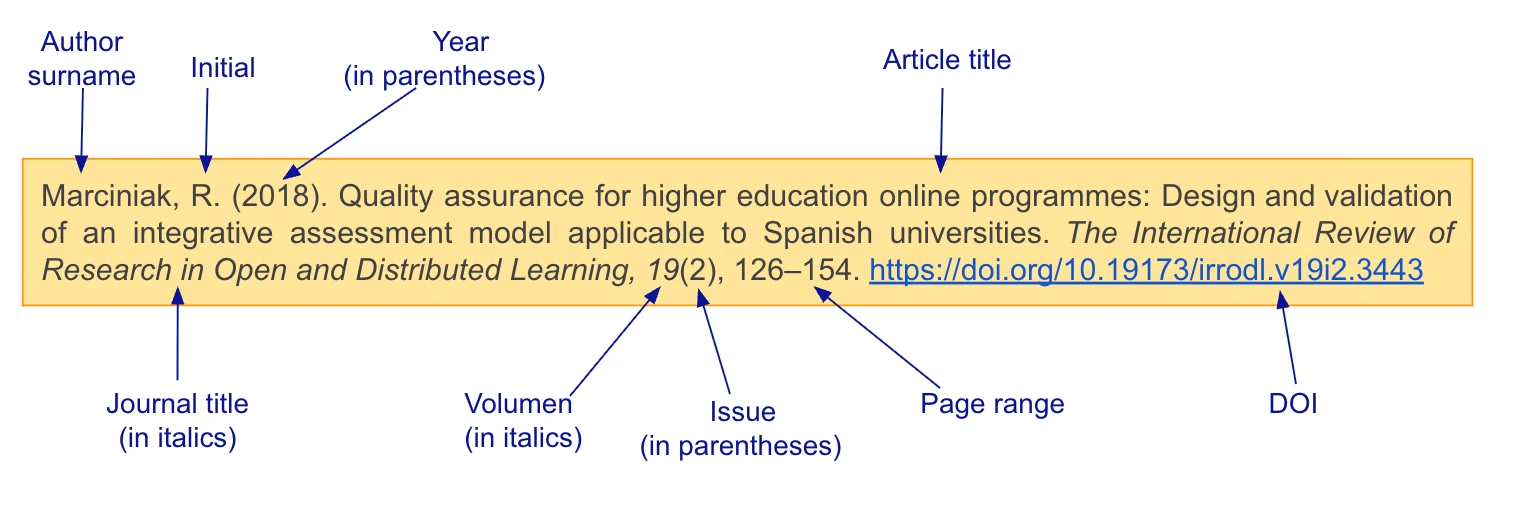
Journal articles are one of the most common sources used in academic writing. In APA 7, a journal article reference usually includes the author, year, title of the article, title of the journal, volume number, issue number, page range, and DOI if available.
Basic format:
Author, A. A. (Year). Title of the article. Title of the Journal, volume(issue), page numbers. https://doi.org/xxxxx
Example:
Marciniak, R. (2018). Quality assurance for higher education online programmes: Design and validation of an integrative assessment model applicable to Spanish universities. The International Review of Research in Open and Distributed Learning, 19(2), 126–154. https://doi.org/10.19173/irrodl.v19i2.3443
2. Journal article without issue number
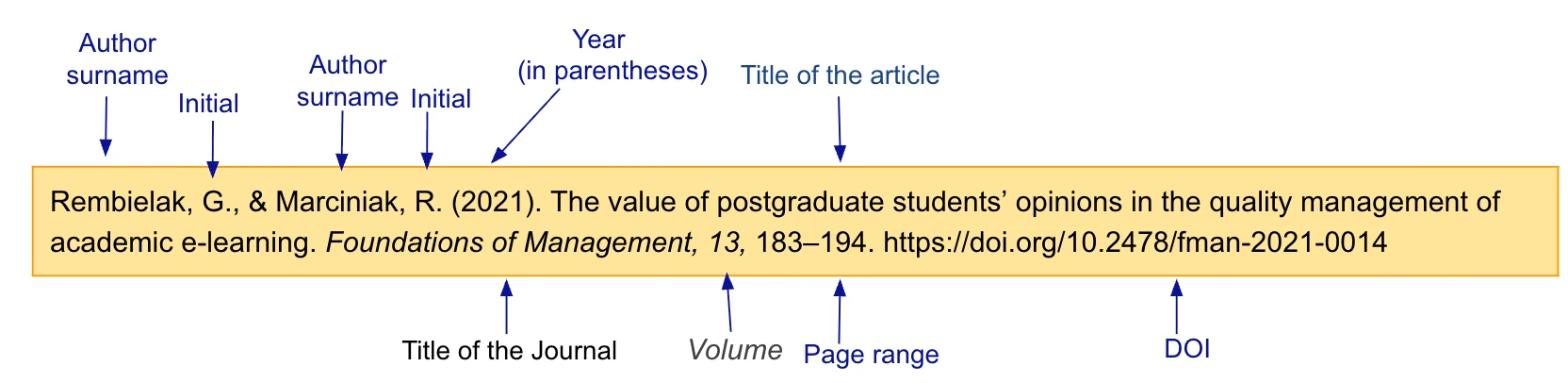
Sometimes a journal article has a volume number but no issue number. In that case, only the volume number is included.
Basic format:
Author, A. A. (Year). Title of the article. Title of the Journal, volume, page numbers. DOI
Example:
Rembielak, G., & Marciniak, R. (2021). The value of postgraduate students’ opinions in the quality management of academic e-learning. Foundations of Management, 13, 183–194. https://doi.org/10.2478/fman-2021-0014
3. Online newspaper article
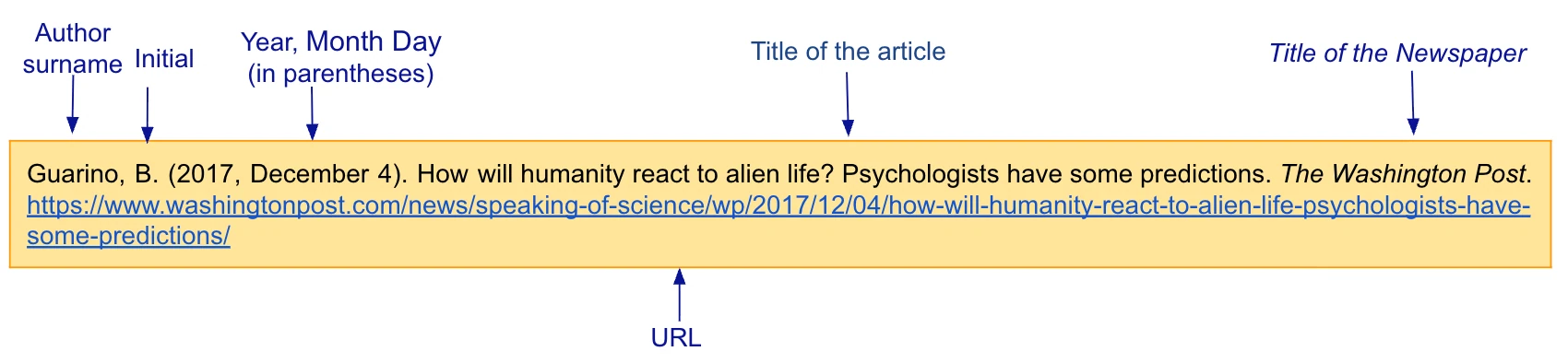
If the newspaper article is available online, include the URL at the end of the reference.
Basic format:
Author, A. A. (Year, Month Day). Title of the article. Title of the Newspaper. URL
Example:
Guarino, B. (2017, December 4). How will humanity react to alien life? Psychologists have some predictions. The Washington Post. https://www.washingtonpost.com/news/speaking-of-science/wp/2017/12/04/how-will-humanity-react-to-alien-life-psychologists-have-some-predictions/
4. Website with a publication date
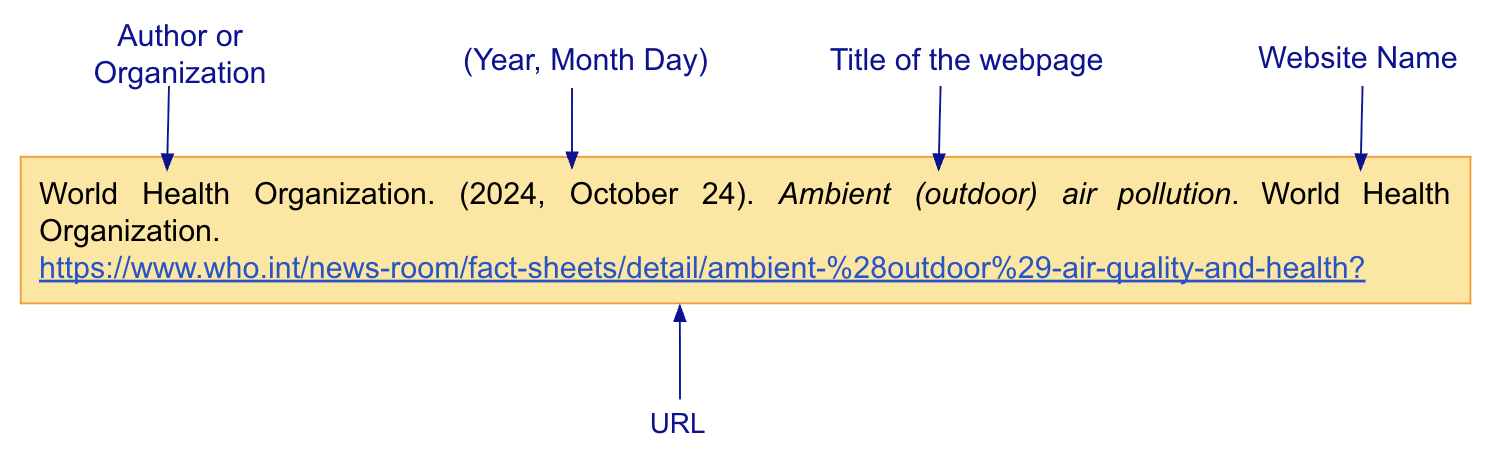
A website reference usually includes the author or organization, date, title of the webpage, website name if needed, and URL.
Basic format:
Author or Organization. (Year, Month Day). Title of the webpage. Website name. URL
Example:
World Health Organization. (2024, October 24). Ambient (outdoor) air pollution. World Health Organization. https://www.who.int/news-room/fact-sheets/detail/ambient-%28outdoor%29-air-quality-and-health?
5. Website without a publication date
If no publication date is available, use “n.d.,” which means “no date.”
Basic format:
Author or Organization. (n.d.). Title of the webpage. Website Name. URL
Example:
UNICEF. (n.d.). What we do. https://www.unicef.org/what-we-do
Common mistakes
Students often make several mistakes when preparing references for articles and websites. The most common mistake is copying only a URL instead of preparing a full reference. Another frequent mistake is forgetting the DOI for journal articles, which also matters when you build your in-text citations. Students also often write article titles incorrectly, use capital letters where they are not needed, or forget to italicize the journal or newspaper title.