


Many students prepare a reference list at the end of their academic paper, but they do not cite the authors inside the text. This is a common mistake. A reference list alone is not enough because the reader cannot see which ideas, data, or arguments come from which source.
In APA style, sources must be cited both in the text and in the reference list. When in-text citations are missing, the paper may look less credible and less academic. It may also lead to a lower grade, because the student does not clearly show how the sources were used in the work.
This article explains the basic rules for citing sources in the text according to APA Style.
Parenthetical vs. Narrative citation
In APA Style, there are two common ways to cite sources in the text: parenthetical citations and narrative citations. In a parenthetical citation, the author’s surname and the year are placed in parentheses, for example, (Smith, 2021). In a narrative citation, the author’s surname is part of the sentence, and only the year is placed in parentheses, for example, Smith (2021).
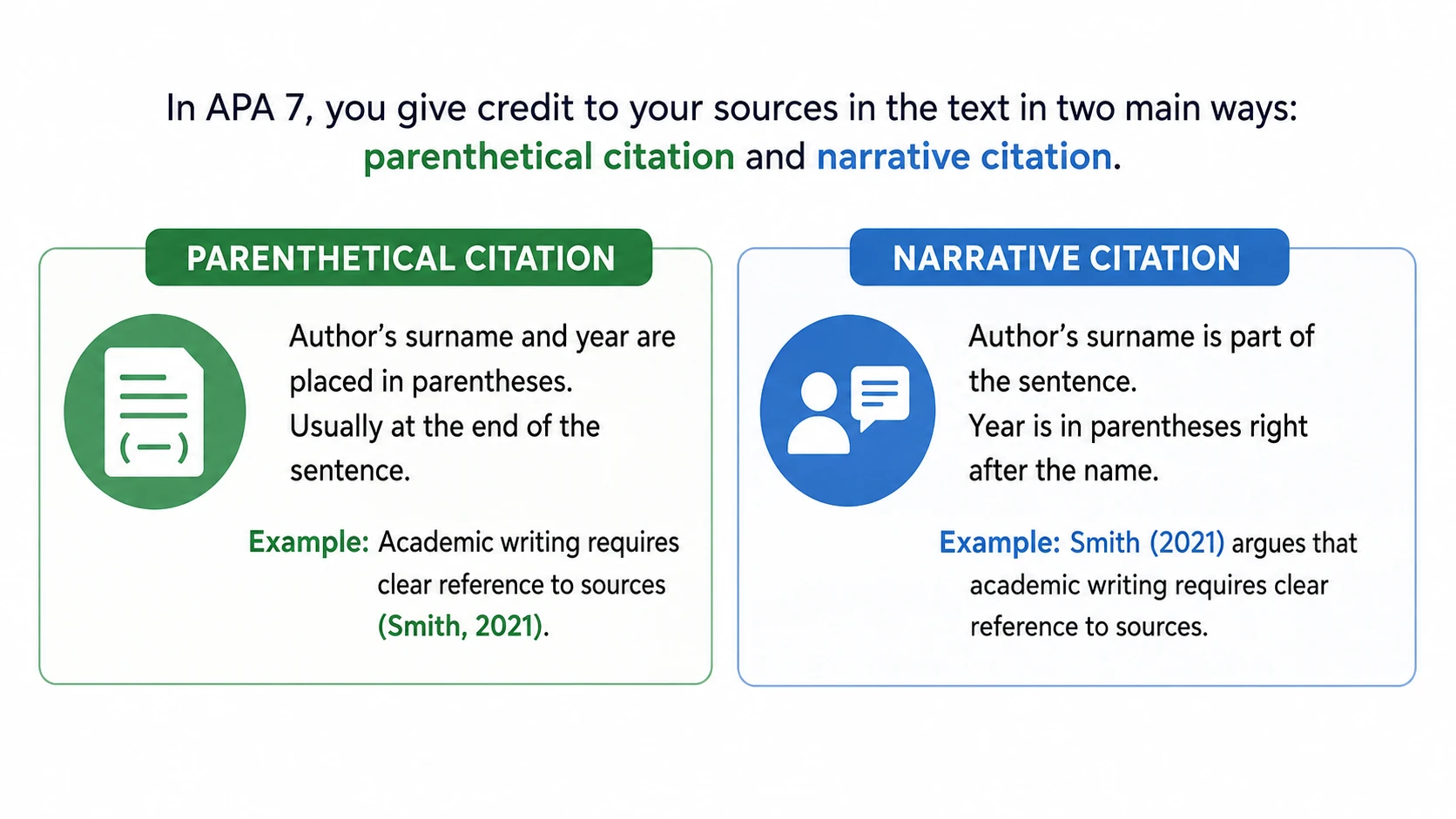
Basic rules for in-text citations in APA Style
1. One author
When a source has one author, include the author’s surname and the year of publication.
Parenthetical citation: (Smith, 2021)
Academic writing requires clear reference to sources (Smith, 2021).
Narrative citation:
Smith (2021) argues that academic writing requires clear reference to sources.

2. Two authors
When a source has two authors, include both surnames every time you cite the source.
Parenthetical citation: (Smith & Brown, 2020)
Example: Students should use reliable sources in academic papers (Smith & Brown, 2020).
Narrative citation:
Smith and Brown (2020) explain that students should cite sources consistently.

3. Three or more authors
When a source has three or more authors, include only the first author’s surname followed by et al. The same rule applies to multi-author book references.
Parenthetical citation: (Smith et al., 2020)
Correct in-text citation is necessary to show which source was used (Smith et al., 2020).
Narrative citation:
Smith et al. (2020) show that correct citation helps improve the credibility of academic work.

4. Source without an author
When a source does not have an author, use the title instead of the author’s surname.
Parenthetical citation: (Managing Change, 2017)
Students should cite every source that they use in the text (Academic Citation Guide, 2021).
Narrative citation:
Managing Change (2017) discusses the importance of decision-making in difficult situations.

5. Source without a date
When a source does not have a publication date, use n.d., which means “no date.” This often happens with websites and other online sources.
Parenthetical citation: (American Psychological Association, n.d.)
Students should use n.d. when a source has no publication date (American Psychological Association, n.d.).
Narrative citation:
The American Psychological Association (n.d.) explains how to prepare references in APA style.

6. Several sources in one citation
When you cite more than one source in the same parentheses, arrange them alphabetically and separate them with semicolons.
Example: (Brown, 2013; Johnson & Miller, 2017; Smith et al., 2016)
Using in-text citations helps readers identify the sources used in academic writing and connect them with the reference list (Brown, 2019; Johnson & Miller, 2021; Smith et al., 2020).
In this example, the sentence is not based on only one source. It refers to a general idea supported by several publications.