


Books are one of the most common sources used in academic writing, but preparing book references in APA 7 can be confusing for many students. A correct book reference is not just the title of the book or a link found online. It must include specific elements, such as the author, year of publication, title, edition if applicable, publisher, and DOI or URL when available.
This article presents six basic rules that will help students understand how book references are structured in APA 7 and how to avoid the most common mistakes when preparing a reference list.
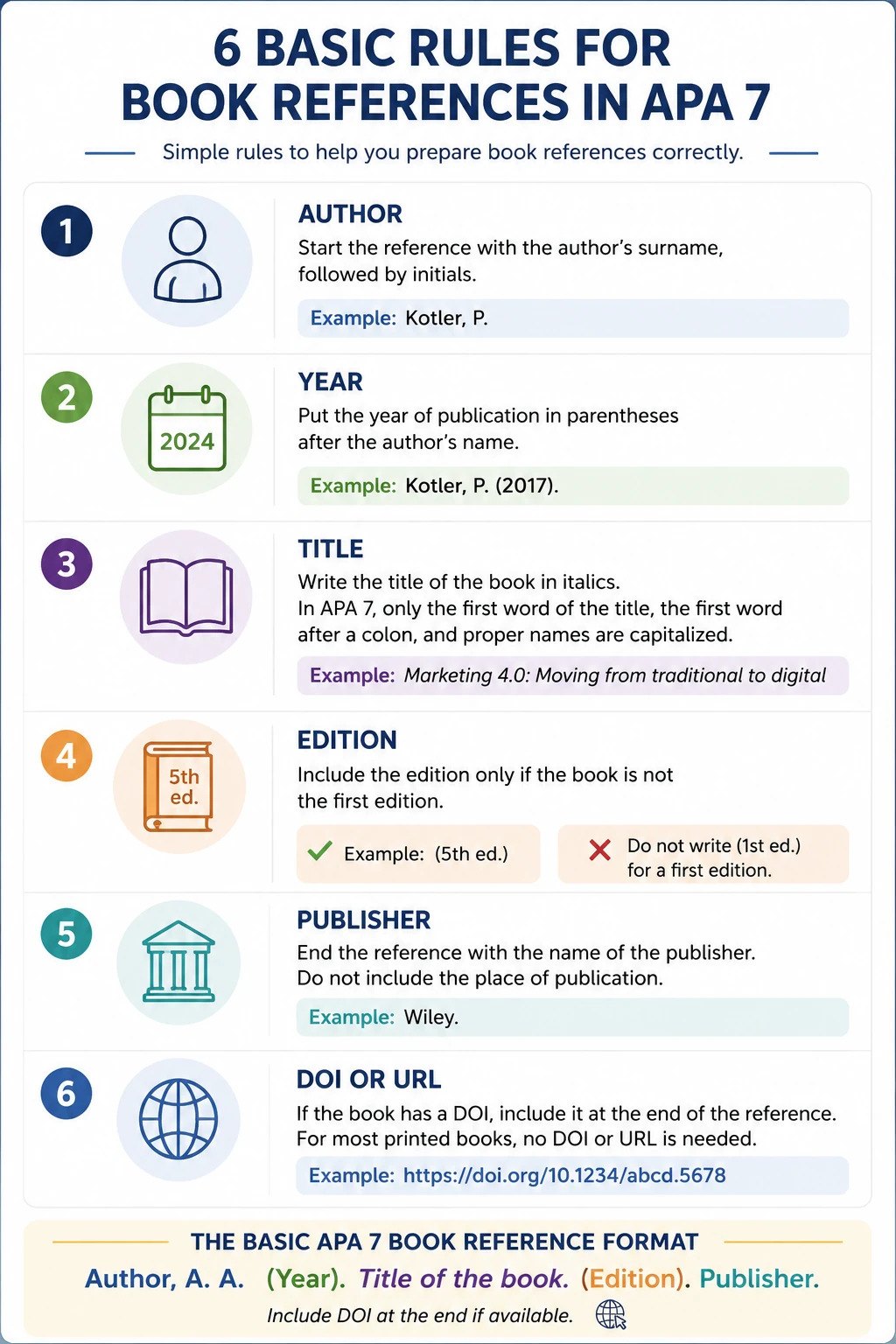
1. Author
Start the reference with the author’s surname, followed by initials.
Example: Kotler, P.

2. Year
Put the year of publication in parentheses after the author’s name.
Example: Kotler, P. (2018).

3. Title
Write the title of the book in italics. In APA 7, only the first word of the title, the first word after a colon, and proper names are capitalized.
Example: Marketing 4.0: Moving from traditional to digital

4. Edition
Include the edition only if the book is not the first edition.
Example: (5th ed.)

5. Publisher
End the reference with the name of the publisher. Do not include the place of publication.
Example: Wiley.

6. DOI or URL
If the book has a DOI, include it at the end of the reference. For most printed books, no DOI or URL is needed. The same end-of-reference logic applies to journals, newspapers, and websites, where a DOI or URL is far more common.

Preparing book references in APA Style becomes much easier when students understand the logic of the reference: who wrote the book, when it was published, what its title is, and where it was published. The same basic structure is used in most book references, although small changes may appear depending on the number of authors or the type of book. Once the reference list entry is correct, it is much easier to match it with the right in-text citations. By following these six rules, students can prepare clearer, more accurate, and more professional reference lists.