


Every research project starts with a problem. If there is no problem, there is no real research.
A research problem is the foundation of the whole study. It shows what needs to be explained, understood or improved. Without a clearly defined problem, it is difficult to formulate research questions, choose a method, collect data or write conclusions.
1. What is a research problem?
A research problem is the starting point of a study. It shows that there is a situation, difficulty or gap that should be analysed.
For example:
Some restaurants receive positive customer reviews about food quality, but negative reviews about service. This shows that the quality of service may be a problem in these restaurants and should be investigated. The study should therefore investigate how customers evaluate service quality and which elements of the service experience need improvement.

2. How to identify a research problem
A research problem can come from different sources.
The first source is observation of reality. For example, a student may notice that many customers say they care about healthy food, but often choose fast food.
The second source is scientific literature. When reading articles, students can find what has already been studied and what still needs further research.
The third source is expert opinion. Teachers, professionals or people working in a specific sector can help identify real problems that are worth investigating.
So, before writing the problem, it is useful to ask:
- What do I observe?
- What do experts say?
- What does the literature say?
3. The problem must be clear and researchable

For example, this problem is too general:
The problem of good management in restaurants.
It is not clear what “good management” means. Does it refer to leadership, communication, planning, motivation or control?
A better version would be:
It is unclear how communication between managers and employees affects employee motivation in small restaurants.
This version is better because it includes specific elements that can be studied: communication, managers, employees, motivation and small restaurants.
4. Descriptive and explanatory research problems
There are two types of research problems:
-
A descriptive problem helps describe or characterise a situation, group, object or phenomenon.
Example:
What are the main reasons why students use AI tools when writing academic papers?
This problem describes students’ behaviour.
-
An explanatory problem looks for relationships or causes.
Example:
How does the frequency of using AI tools affect students’ confidence in academic writing?
This problem tries to explain the relationship between two variables: use of AI tools and confidence in writing.
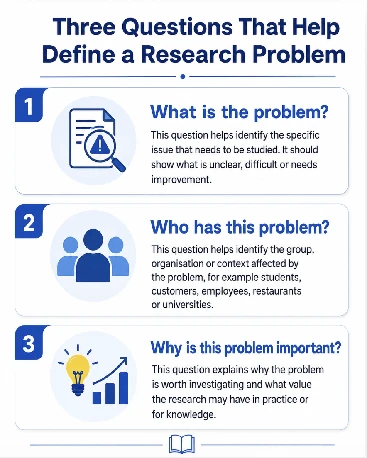
5. Common mistakes when defining a research problem
-
The first mistake is making the problem too general.
Too general:
What is the role of marketing in business?Better:
How do Instagram promotions influence young customers’ decision to visit small restaurants in Barcelona? -
The second mistake is using unclear words.
Too unclear:
How does good management affect employees?Better:
How does manager feedback affect employee motivation in small restaurants? -
The third mistake is choosing a problem that cannot be studied with real data.
Too abstract:
Why is happiness important at work?Better:
How do restaurant employees describe the factors that influence their job satisfaction?