


Research methods are the tools and procedures used to collect and analyse information. They help researchers answer questions, solve problems and understand reality in a more organised way.
Research methods explain how a study is carried out.
They sit inside the wider plan for the study, its research design, which sets out the type of research being carried out.
For example, imagine that a restaurant wants to know why some customers do not return after their first visit. The restaurant may ask customers to complete a survey, interview them, observe their behaviour or analyse online reviews. All these actions are examples of research methods.
Main types of research methods
Research methods are usually divided into three main types: qualitative, quantitative and mixed methods.
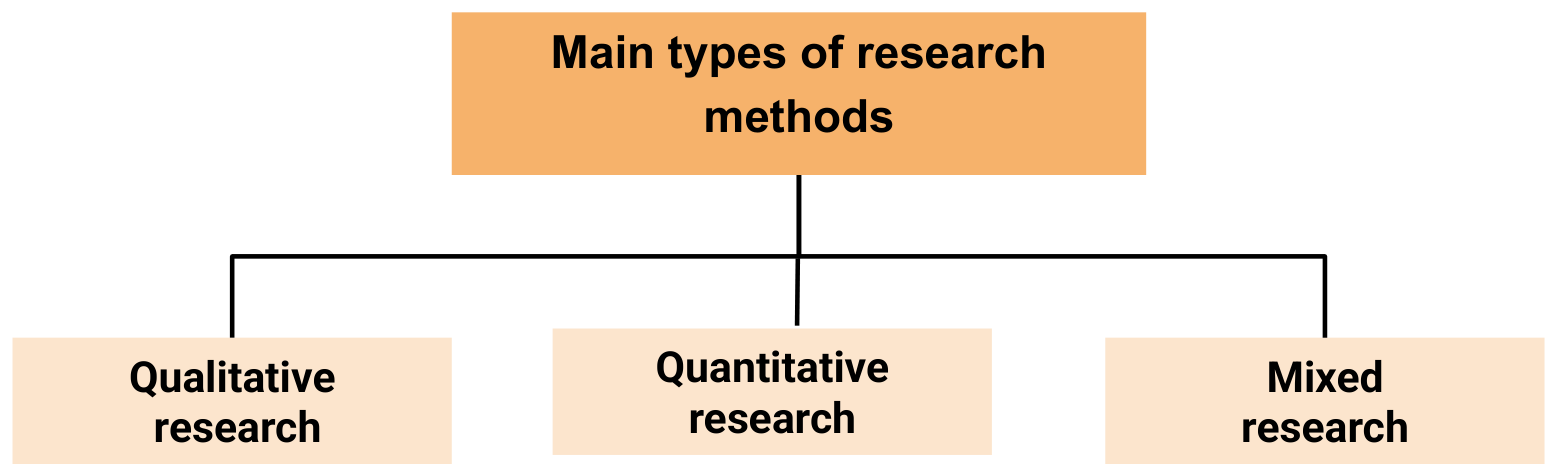
1. Qualitative research methods
Qualitative methods are used when the researcher wants to understand opinions, experiences, emotions or meanings.
They do not focus mainly on numbers. Instead, they help explain why people think or behave in a certain way.
Common qualitative methods include:
| Method | What it is used for |
|---|---|
| Interview | To understand personal opinions or experiences |
| Focus group | To discuss a topic with a small group of people |
| Observation | To study behaviour in a real situation |
| Document analysis | To analyse texts, reports, reviews or institutional documents |
For example, if a researcher wants to understand how students feel about using artificial intelligence in education, interviews may be a good method.
2. Quantitative Research Methods
Quantitative methods are used when the researcher wants to collect numerical data and identify patterns, relationships or differences. These methods help answer questions such as: How many? How often? to what extent? Is there a relationship between two variables?
Common quantitative methods include:
| Method | What it is used for |
|---|---|
| Surveys | To collect information from a larger group of people and identify general patterns. |
| Questionnaires | To ask structured questions and obtain comparable answers. |
| Experiments | To test whether one factor causes a change in another factor. |
| Statistical analysis | To analyse numerical data, find patterns, relationships or differences. |
For example, a researcher may ask 300 students how often they use ChatGPT for academic work. The answers can then be counted and analysed statistically.
3. Mixed research methods
Mixed methods combine qualitative and quantitative approaches.
This means that the researcher uses both numbers and deeper explanations.
For example, a study about customer satisfaction in restaurants may include:
| Quantitative part | Qualitative part |
|---|---|
| A survey with closed questions | Interviews with selected customers |
| Statistical analysis of ratings | Analysis of open comments |
| Percentages and averages | Personal opinions and explanations |
Mixed methods are useful when the researcher wants to obtain a more complete view of the problem.
How to Choose the Right Research Method
The choice of research method depends on the research question.
If the researcher wants to measure something, a quantitative method may be suitable. If the researcher wants to understand experiences or opinions, a qualitative method may be better.
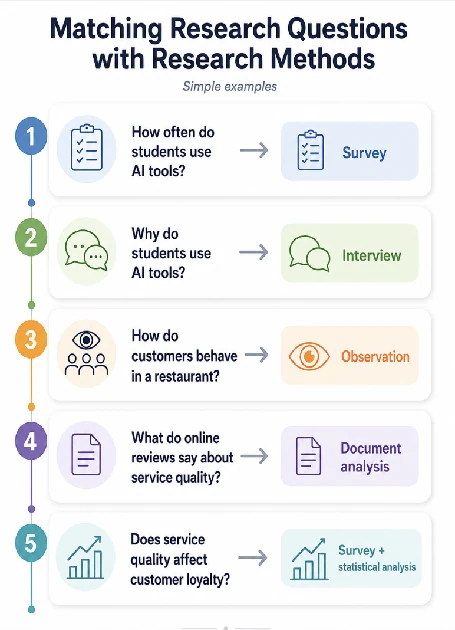
Choosing the right research method is one of the most important steps in any research project. A good method makes the study more reliable, more useful and easier to understand.