


When students or researcher start preparing a research paper, they often focus first on the topic. However, a good topic is not enough. A research paper also needs a clear plan. This plan is called research design.
Research design explains how the study will be organized and conducted. For a step-by-step guide, see how to write a research design. It helps the researcher decide what type of information is needed, how the data will be collected and what kind of results the study should provide.
One simple way to understand research design is to divide it into three main types:
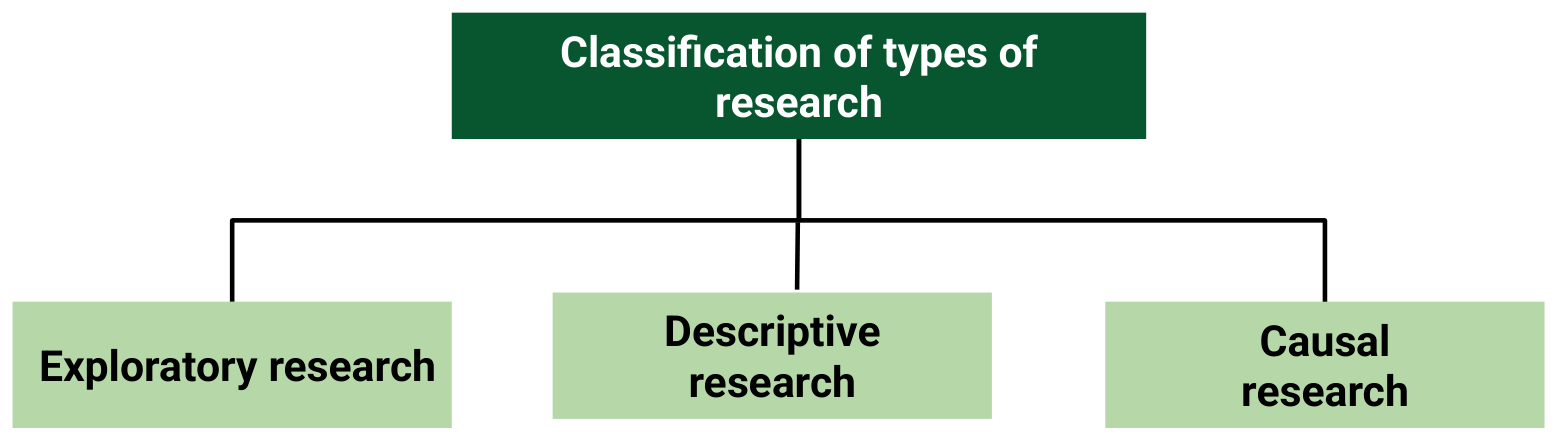
1. Exploratory research design
Exploratory research design is used when the topic is still new, unclear or not well understood. The researcher does not try to prove something immediately. Instead, the goal is to collect preliminary information and better understand the problem.
This type of design is useful at the beginning of a research project. It can help define the research problem, identify important factors and suggest possible hypotheses.
For example, a researcher may want to understand why some restaurant customers do not return after their first visit. At this stage, interviews with customers or an analysis of online reviews can help discover possible reasons.
2. Descriptive research design
Descriptive research design is used when the researcher wants to describe a situation, group, behavior or phenomenon. In this case, the research problem is usually clearer than in exploratory research.
The aim is to show what is happening, how often it happens or what characteristics a group has, rather than to explain why it happens.
For example, a researcher may conduct a survey to describe customer satisfaction in a restaurant. The study may show how customers evaluate food quality, service, atmosphere and price.
3. Causal research design
Causal research design is used when the researcher wants to test whether one factor has an effect on another. It focuses on cause-and-effect relationships.
This type of design is more structured because the researcher usually works with a specific hypothesis. The aim is to check whether a change in one variable produces a change in another variable.
For example, a researcher may want to test whether faster service increases customer satisfaction. In this case, service speed is one variable, and customer satisfaction is another.
Comparison of three types of research design
Exploratory, descriptive and causal research design
| Aspect | Exploratory research design | Descriptive research design | Causal research design |
|---|---|---|---|
| Main purpose | To explore a problem and collect preliminary information. | To describe a situation, group or phenomenon. | To test cause-and-effect relationships. |
| When it is used | When the topic is new, unclear or not well understood. | When the researcher wants to describe what is happening. | When the researcher wants to test the effect of one variable on another. |
| Research question | What is happening? What could be important? | What are the characteristics of this situation or group? | Does X influence Y? |
| Data collection | Interviews, observations, document analysis, reviews. | Surveys, observation, institutional data, reports. | Experiments, structured surveys, controlled comparisons. |
| Sample | Usually small and flexible. | Usually larger and more clearly defined. | Clearly defined and controlled. |
| Data analysis | Mostly qualitative or preliminary analysis. | Usually descriptive statistics or structured analysis. | Statistical analysis or comparison of groups. |
| Results | Initial ideas, better understanding of the problem, possible hypotheses. | Description of facts, behaviors, opinions or characteristics. | Evidence about possible relationships between variables. |
Each type of research design has a different purpose. Exploratory research design helps understand a problem when little is known about it. Descriptive research design helps present what is happening in a clear and organized way. Causal research design helps test whether one factor influences another.
Choosing the right research design is important because it makes the study more logical, realistic and easier to conduct.