


Whether AI supports learning depends on how a student uses it. Students need to develop their own ideas, assess AI responses, and make decisions about their writing at each stage. UNESCO’s guidance on generative AI in education and research puts human agency and learning at the centre of that interaction (Miao & Holmes, 2023).
The six practices below keep the student involved in the work. Follow the rules for your assignment when deciding which uses are permitted. For the research behind these uses and their limits, see writing with AI while still learning.
1. Start with your own ideas or draft
Try the task yourself before asking AI for help. Write down your ideas or prepare a first draft. This gives you something of your own to compare with the tool’s suggestions and makes it easier to judge what they add.
You can then decide which suggestions help you develop the assignment and which do not fit your argument.
2. Ask for explanations and suggestions
Give AI your draft and ask it to identify missing elements or errors, with suggestions for how you could address them. Make the changes yourself. You can then ask whether the revision addresses the original problem.
For a management assignment, a student could use the following prompt to review a SWOT analysis. SWOT separates a company’s internal strengths and weaknesses from external opportunities and threats.
Example prompt
I am a management student preparing a SWOT analysis of [company name], which operates in [industry]. I want to check whether I have correctly identified its strengths and weaknesses, and the opportunities and threats in its environment.
Here is my analysis: [paste your analysis].
- Assess whether my analysis clearly identifies the company, its strengths and weaknesses, its opportunities and threats, and whether I have assigned each factor to the right category. Answer “Yes” or “No” for each criterion and briefly explain your assessment.
- Point out any grammar or style errors.
- Do not write a new analysis or correct mine for me. Give suggestions only.
3. Ask for guiding questions
Ask AI to pose questions that help you examine the problem and reach your own answer. This draws on Socratic questioning, where a question encourages someone to examine their reasoning and develop a conclusion.
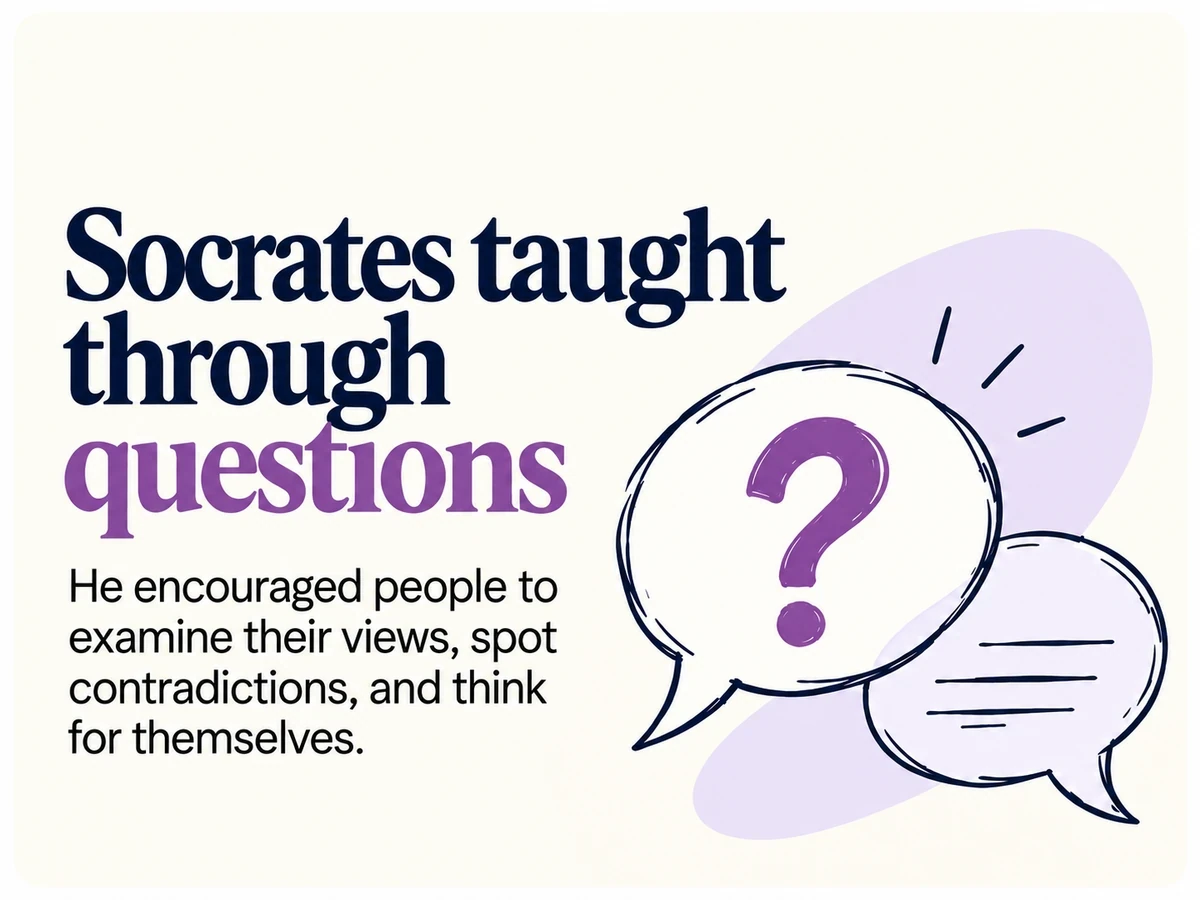 Socrates taught through questions. He encouraged people to examine their views, spot contradictions, and think for themselves.
For the SWOT assignment, try:
Example prompt
Help me prepare a SWOT analysis of company X. Ask me one question at a time to help me identify its strengths and weaknesses. Wait for my answer after each question. Do not give me a ready-made answer.
4. Use AI for feedback on the whole draft
Ask AI to identify unclear passages, arguments that do not connect to the main point, and places that need a better explanation. Ask why a reader might struggle with them. You decide which comments to accept and which to reject.
For example:
Example prompt
My assignment needs to explain why [enter the topic, main point, or question you need to answer]. Here is my draft: [paste or attach your assignment].
Identify passages that may be unclear and arguments that do not connect logically. Explain why a reader might find them difficult, and ask questions that help me decide how to improve the text. Do not rewrite the assignment or supply ready-made wording.
5. Check the answers and sources
AI can give incorrect information or refer to sources that do not exist. Check that each suggested source exists and that it supports the claim attached to it. Compare the output with research publications, course materials, and other reliable sources.
Checking those connections gives you practice in judging information and helps you understand the topic. When you use an idea from a source, cite the original work, including when you paraphrase it.
6. Follow your lecturer’s or university’s rules
Check the AI use rules for the assignment. If they require disclosure, briefly describe which tool you used, for what purpose, and at which stage. Explain how you used its suggestions.
Where the rules ask for or permit it, include screenshots of the conversation or a link to it. Documenting the assistance helps you distinguish your contribution from what the tool supplied.
Use the writing history for self-review
Turingo analyses the history of a document and shows how its text changed during writing. Students can revisit the stages of an assignment, see which passages they developed or revised, and reflect on their own contribution.
Use that history to ask whether you developed the arguments yourself, checked the information, and critically assessed the AI suggestions. For a lecturer, the same history can provide additional context for feedback on the writing process and identify points to discuss with the student.
The “Human Written” indicator and a record of pasted text do not automatically identify the source of a passage. Pasted text may come from different places. Read the history alongside the assignment, its rules, and the student’s explanation.
Turingo can support self-review and a conversation about AI use. Assessment of the work’s content and the lecturer’s judgement remain necessary.
How to cite this article (APA 7)
Turingo. (2026, October 17). How to use AI for written assignments and still learn. https://turingo.net/blog/how-to-use-ai-for-assignments-and-still-learn
References
Miao, F., & Holmes, W. (2023). Guidance for generative AI in education and research. UNESCO. https://unesdoc.unesco.org/ark:/48223/pf0000386693_eng