


Artificial intelligence is already part of university life. Students use tools such as ChatGPT, DeepL, Grammarly, image generators and other AI-based applications to search for ideas, improve language, translate texts or prepare assignments. The real question is no longer whether students will use AI, but how they should use it responsibly.
Many universities are now developing institutional AI policies. However, a general university policy is often not enough for everyday teaching. Each course, assignment and learning objective may require different rules. This is why lecturers need their own clear AI use policy for their courses.
A good AI policy does not have to be long or complicated. It should simply explain what is permitted, what is not permitted, and how students should report the use of AI tools. To see how a text actually came together, the free Turingo Replayer replays a document’s revision history.
Why lecturers need their own AI policy
Students often receive mixed messages about AI. In one course, they may be encouraged to use AI for brainstorming. In another course, the same practice may be considered inappropriate. This creates confusion and may lead to unintentional academic misconduct.
A course-level AI policy helps solve this problem. It gives students practical guidance from the beginning of the semester. It also protects the lecturer, because expectations are clearly stated before students submit their work.
For lecturers, an AI policy does more than set limits. It teaches students how to use AI critically. In higher education, students should learn how to think, analyse, compare sources, make decisions and develop their own arguments. AI can support this process, but it should not replace it.
What should be permitted?
AI tools can be used as support tools, not as substitutes for student work. Students may use AI for activities that help them begin, improve or organise their learning process.
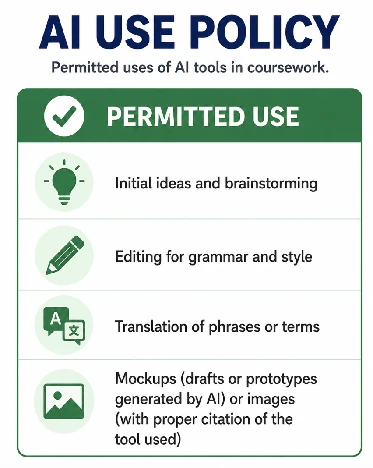
AI use may be permitted for:
Initial ideas and brainstorming.
Students may ask AI tools for possible topics, examples, structures or perspectives. However, they must decide which ideas are useful and adapt them to the specific assignment.
Editing grammar and style.
AI may help students correct grammar, improve clarity or make a text easier to read.
Translation of phrases or terms.
Students may use AI to translate short expressions, technical terms or individual sentences. However, they should not submit a fully translated text without checking accuracy, meaning and context.
Mockups, drafts, prototypes or images.
AI may be used to generate visual ideas, draft examples, mockups or images, but students must indicate which tool they used and how they modified the result.
The key idea is simple: AI may help students with the process, but the final academic responsibility remains with the student.
What should not be permitted?
Students should also understand that some uses of AI are not acceptable. These rules need to be direct and easy to understand.
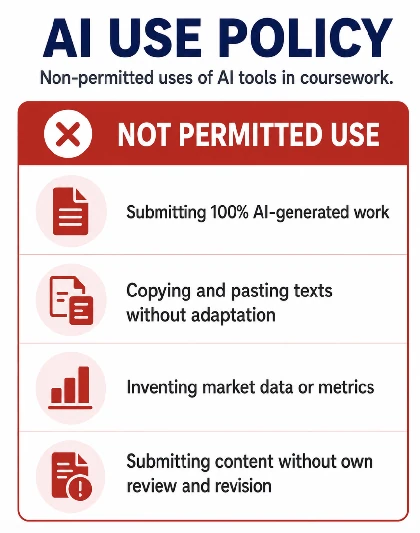
The following uses should not be permitted:
Submitting 100% AI-generated work.
Students cannot ask AI to complete an entire assignment and submit it as their own work. This does not show learning, critical thinking or personal contribution.
Copying and pasting AI-generated text without adaptation.
Even if a student uses AI for support, the text must be revised, adapted and connected to the task. Copy-paste work usually lacks personal analysis and often does not respond properly to the assignment.
Inventing data, market information or metrics.
AI tools may generate convincing but false information. Students must not include invented statistics, fake references, false market data or unsupported claims.
Submitting content without personal review and revision.
Any AI-supported content must be checked by the student. The student is responsible for the final version, including accuracy, sources, logic and language.
Transparency: The most important rule
One of the most practical parts of an AI policy is the requirement to disclose AI use. Students should not hide the use of AI tools. Instead, they should explain it clearly.
In the final bibliography or at the end of the assignment, students should include a short section titled: AI Tool Use.
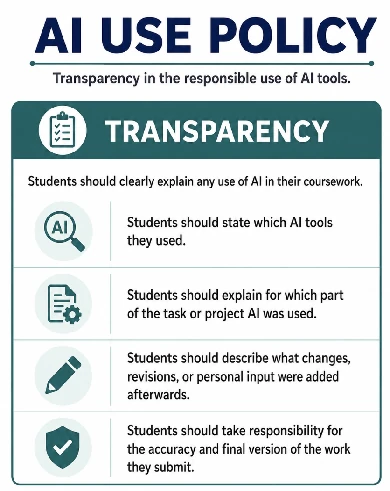
In this section, students should explain:
- Which AI tools were used.
- For which part or phase of the project they were used.
- What modifications, corrections or revisions were made afterwards.
For example:
AI Tool Use: ChatGPT was used to generate initial ideas for the customer journey map. The final structure, examples and analysis were developed and revised by the student. Grammarly was used to correct grammar and improve clarity.
This type of statement helps lecturers understand the student’s working process. It also teaches students that transparency is part of academic integrity.
How lecturers can introduce the policy to students
The AI policy should not be hidden in a syllabus that students never read. It should be explained in class, preferably at the beginning of the course.
A good way to introduce it is to show students a simple visual guide with two columns: permitted use and not permitted use. This makes the rules easier to remember.
Lecturers can also discuss short examples with students:
- Is it acceptable to use AI to correct grammar?
- Is it acceptable to ask AI to write the whole assignment?
- Is it acceptable to use AI-generated market data?
- Is it acceptable to use AI for brainstorming and then write the final text independently?
These questions help students understand the difference between support and substitution.
AI policy as part of learning
An AI policy should not be seen only as a disciplinary document. It is also a teaching tool. It helps students develop digital responsibility, academic honesty and critical thinking.
Students need to understand that AI can be useful, but it is not always reliable. It can produce incorrect information, superficial analysis or texts that sound convincing but say very little. Therefore, students must learn to verify, revise and improve AI-generated content.
For lecturers, detecting AI use is only the starting point. What matters more is designing learning activities where students still need to think, decide, explain and justify their work.
For examples to discuss with students, see six ways to use AI for assignments while still learning. The companion guide to AI support and its limits in writing reviews the research and explains when a tool takes over the work students need to practise.