


The theoretical background of a thesis explains the concepts, theories and earlier research that your study builds on. It gives readers the knowledge they need to understand your question and the work that follows. In a research-based thesis, this chapter usually comes before the methodology.
Choose sources that serve your research aim. If you are studying customer loyalty in restaurants, explain what loyalty means and what may influence it. A history of the entire hospitality industry would take you away from the question you are investigating.
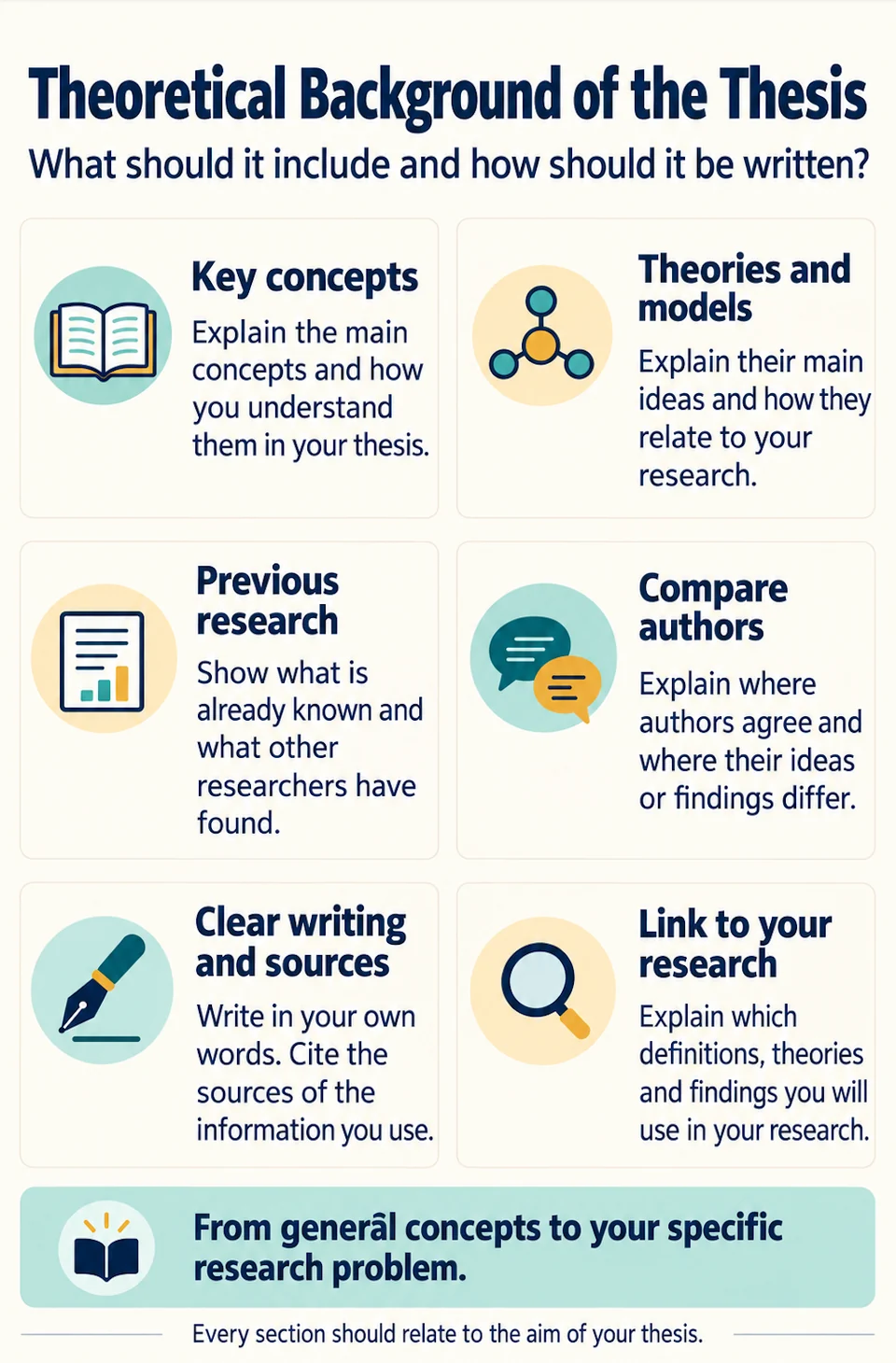
Move from broad concepts to your research problem
Begin with the terms a reader needs to know. Then introduce the theories and models relevant to your topic, followed by findings from earlier studies. Each section should bring the reader closer to the specific research problem you will investigate.
Divide the chapter into subsections on distinct ideas, but use only as many as you need. Leave space in the thesis for your own research and findings.
Explain the definitions you use
When several authors define the same term, explain where their definitions overlap and differ. For customer loyalty, state which author’s definition you will use in your thesis. Readers can then see what you mean by loyalty when you measure or discuss it later.
Show what each theory or model contributes
Explain the main ideas of each theory or model and name its author. Say why it belongs in your thesis. If you will use a model to design a questionnaire or propose an improvement plan, identify that use here.
Compare what other researchers have found
Group studies that address the same question and compare their findings. In research on restaurant loyalty, one author might focus on service, another on atmosphere and another on the overall customer experience. Explain where their accounts agree and where they differ.
When studies reach different conclusions, check who took part in each one. A study of diners at a three-Michelin-star restaurant may describe loyalty differently from one focused on fast-food customers. Describe the research setting when you compare the results.
Write in your own words and cite your sources
Write in your own words, keep sentences manageable and explain unfamiliar terms. Cite the source whenever you use another author’s definition, theory, finding or argument, even when you paraphrase it. Mark direct quotations according to your university’s rules.
Follow the citation style your programme requires. If it uses APA 7, see our guide to preparing an APA reference list.
End by connecting the chapter to your study
Close with the definitions and findings you will use in your research. Explain how they shape your question, methods or analysis so readers know what you are studying and the work that supports it.
Keep a clear record of how you wrote your thesis
If your university uses AI detectors, consider saving your outlines and drafts as you write. Automated checks can misidentify human-written work. A document with version history makes it easier to trace how your thesis developed. Follow your programme’s rules for disclosing AI assistance.
With a Turingo plan, you can run a detailed analysis of your Google Docs thesis and create a report to share with your supervisor. For a quick review together in person, the free Replayer lets you walk through the document’s edit history without an account or extension.
Get a shareable reportFor an in-person review, open the free Replayer.