


Writing a thesis is easier when you know what each section is meant to do. The title page identifies the work, the introduction explains the problem, the methods show how you investigated it, and the conclusion answers the question you began with.
This guide uses a research-based thesis as an example. The required sections, their names and their order vary by university and degree programme. Check your department’s template before you start, and use it whenever it differs from the example below.
Thesis structure: 11 parts in order
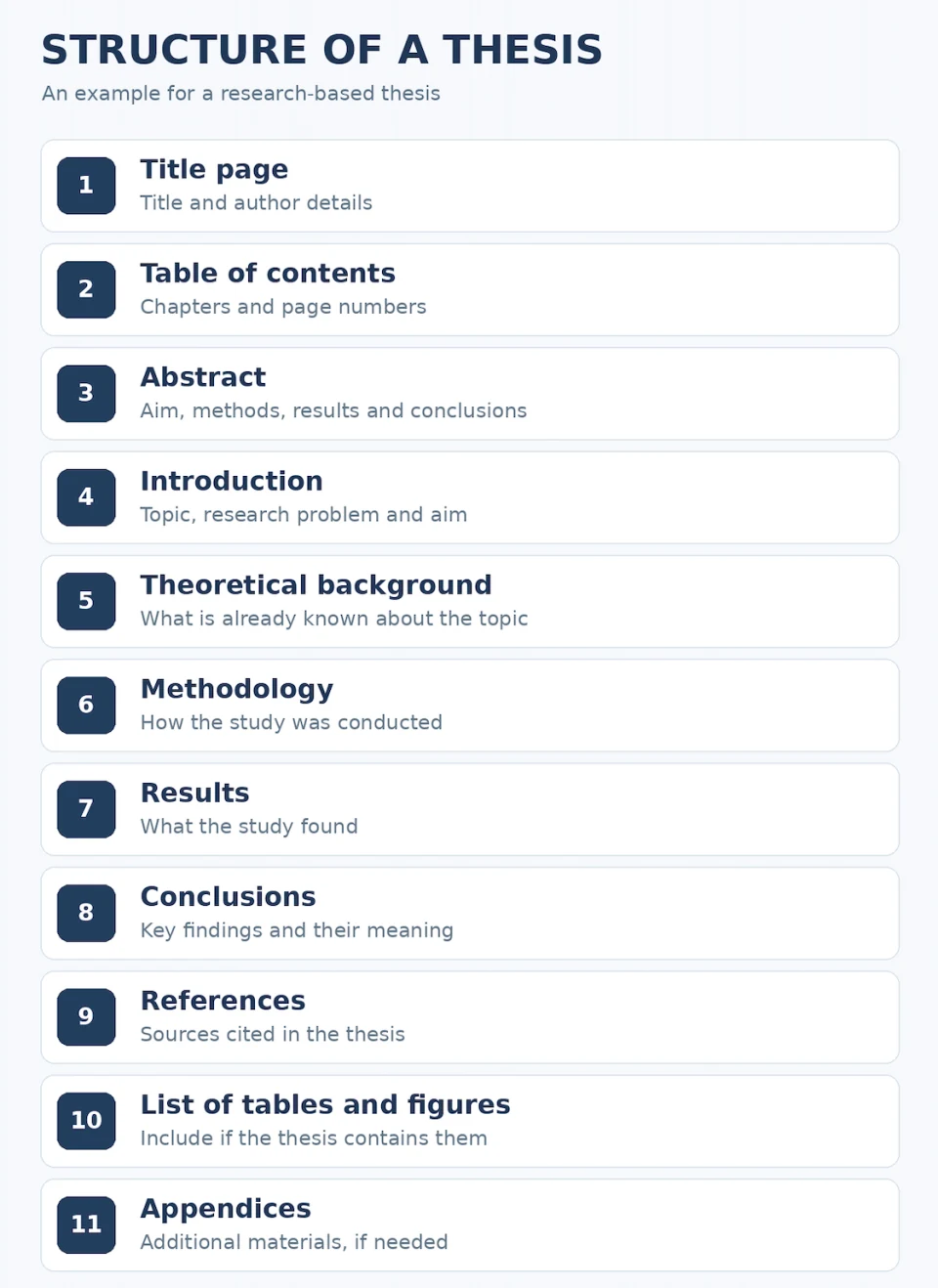
1. Title page
The title page gives the reader the essential details: the university, the thesis title, your name, your supervisor’s name, and the place and year of submission or defence if required. Use your university’s title-page template if it provides one.
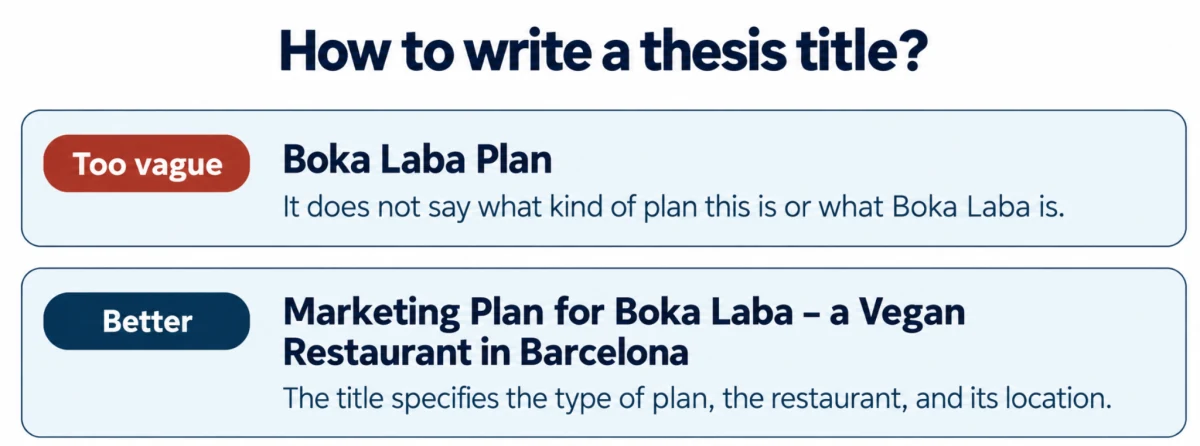
A good title also tells readers what the work covers. Boka Laba Plan leaves the subject unclear; Marketing Plan for Boka Laba, a Vegan Restaurant in Barcelona identifies the type of plan, the business and its location.
2. Table of contents
The table of contents lists chapters and subsections in their order, with the page number where each begins. Create it with your word processor’s automatic contents feature rather than typing the entries and page numbers yourself.
First, apply heading styles consistently: Heading 1 for chapters, Heading 2 for subsections and Heading 3 where you need another level. Then insert the table of contents. Update it after changing titles or moving text so its page numbers match the finished thesis.
3. Abstract and keywords
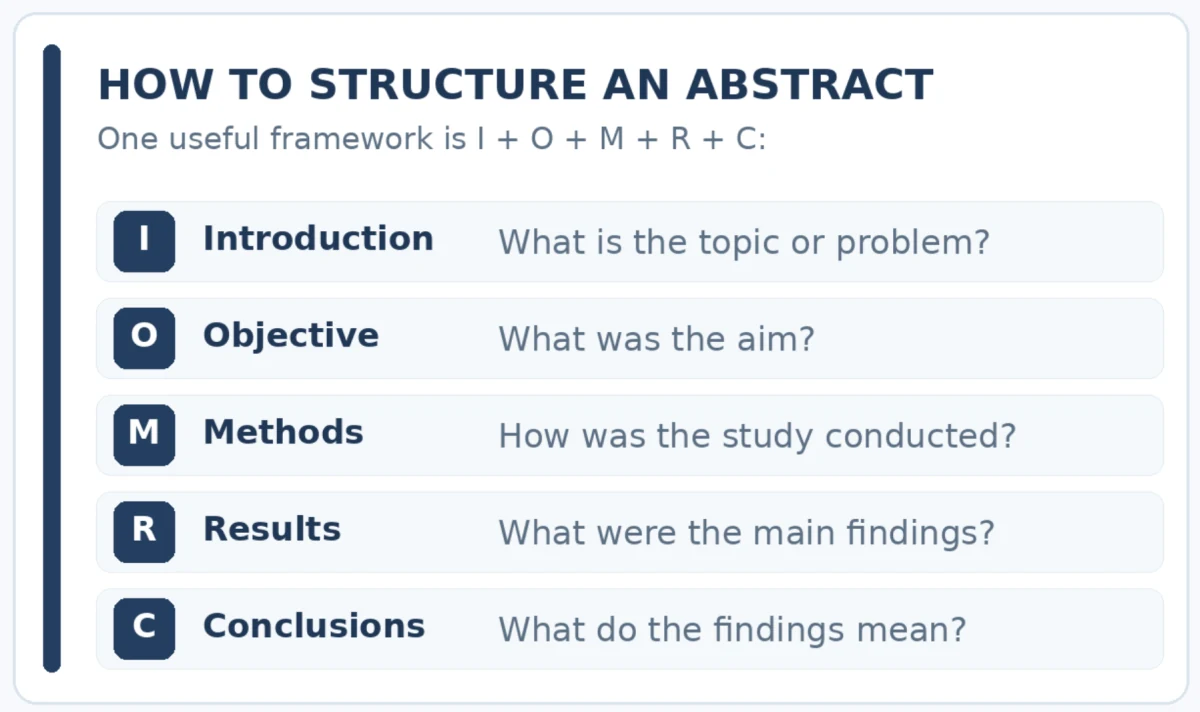
The abstract is a short account of the whole thesis. It tells readers what problem you studied, what you aimed to find out, how you conducted the study, what you found and what those findings mean. It is often easiest to write after the main chapters are complete.
One way to organise it is I + O + M + R + C:
- Introduction: What is the topic or problem?
- Objective: What was the aim?
- Methods: How was the study conducted?
- Results: What were the main findings?
- Conclusions: What do the findings mean?
An abstract of about 150–200 words may be suitable, but follow your university’s word limit and format. Add the requested number of keywords: terms or short phrases that describe the central subject of the thesis. For a study of a restaurant’s customer experience, they might include restaurant, music and customer experience.

4. Introduction
Introduce the topic, define the research problem and explain why it is worth studying. State the main aim of the thesis and, where appropriate, the research questions you will answer. Give the reader a clear route into the work without trying to present every finding at the start.
5. Theoretical background
Explain the concepts, theories and earlier research needed to understand your study. Choose material that helps frame your problem and supports the decisions you make later. Our guide to writing the theoretical background shows how to organise those sources by idea and explain their relationships.
6. Methodology
Show how you carried out the research: the research design, the people or material studied, the data-collection methods and how you analysed the data. Explain why those methods fit your question so a reader can assess the approach.
7. Results
Present the findings that answer your research questions. Use tables or figures where they make a result easier to understand, and explain each one in the text. Your programme may ask you to discuss what the findings mean here or in a separate discussion chapter.
8. Conclusions
Return to the thesis aim and questions. Summarise the main findings, explain what they mean and acknowledge relevant limitations. You can point to questions for future research, but avoid introducing new results here. Our guide to writing a thesis conclusion takes you through those steps.
9. References
List the sources cited in the thesis in the format required by your university. Check that every in-text citation has a matching reference and that every listed source is used in the text. If your programme uses APA 7, our guide to preparing an APA reference list explains the basics.
10. List of tables and figures
If your thesis contains tables or figures and your university asks for a separate list, give each one a clear number and title. Generate the list from captions where your editor supports this, then update it along with the table of contents before submission.
11. Appendices
Place supporting material that readers may need to inspect, but that would interrupt the main argument, in the appendices. Examples include a questionnaire, an interview guide or a large supplementary table. Label each appendix and refer to it at the relevant point in the thesis.
Check the structure before you submit
Read your university’s requirements once more. Confirm that the required sections appear in the right order, the abstract and keywords meet the stated limits, and the contents and figure lists match the final pages. Then read from the introduction to the conclusion and check that your problem and aim lead to the methods, results and answer.
For the next stages of writing, see our guides to choosing research methods, preparing an APA reference list and presenting a master’s thesis.
Keep a clear record of how you wrote your thesis
If your university uses AI detectors, consider saving your outlines and drafts as you write. Automated checks can misidentify human-written work. A document with version history makes it easier to trace how your thesis developed. Follow your programme’s rules for disclosing AI assistance.
With a Turingo plan, you can run a detailed analysis of your Google Docs thesis and create a report to share with your supervisor. For a quick review together in person, the free Replayer lets you walk through the document’s edit history without an account or extension.
Get a shareable reportFor an in-person review, open the free Replayer.